Security Blog & News
Stay updated with the latest vulnerability analyses, security tutorials, and industry news
The Weekly Cybersecurity Brief: March 15th, 2026
March Patch Tuesday lands with public zero-days and fresh RCE risk. Critical patches for Veeam Backup, n8n automation, and Microsoft SharePoint. Loblaw discloses a security incident.
The Weekly Cybersecurity Brief: February 27th, 2026
Dell RecoverPoint zero-day enables root persistence in the wild, critical patches for Ivanti EPMM and Google Chrome, breaches at Figure Technology Solutions and PayPal, and why backup and recovery systems are becoming prime targets.
Why Old CVEs Are Still Your Biggest Security Risk
There's a comforting myth in cybersecurity: that the most dangerous threats are the newest ones. What actually causes breaches, ransomware, and long, awkward incident calls is something far less exciting — old vulnerabilities that never got fixed.
The Weekly Cybersecurity Brief: February 13th, 2026
Six actively exploited Microsoft zero-days hit February Patch Tuesday, critical CVEs in SAP CRM, Catalyst, and Apache Druid demand immediate patching, and Anywhere Real Estate discloses a 17,000-record ERP breach.
Patch Tuesday 2026
Microsoft's February 2026 Patch Tuesday addresses six zero-day vulnerabilities exploited in the wild, along with 54–59 CVEs spanning Windows, Office, Exchange, and Azure.
The Weekly Cybersecurity Brief: February 6th, 2026
ShinyHunters escalated their campaign by publishing datasets from Harvard and UPenn, critical patches for MediaTek SoCs and Autodesk 3ds Max, plus this week's key trends in data extortion tactics.
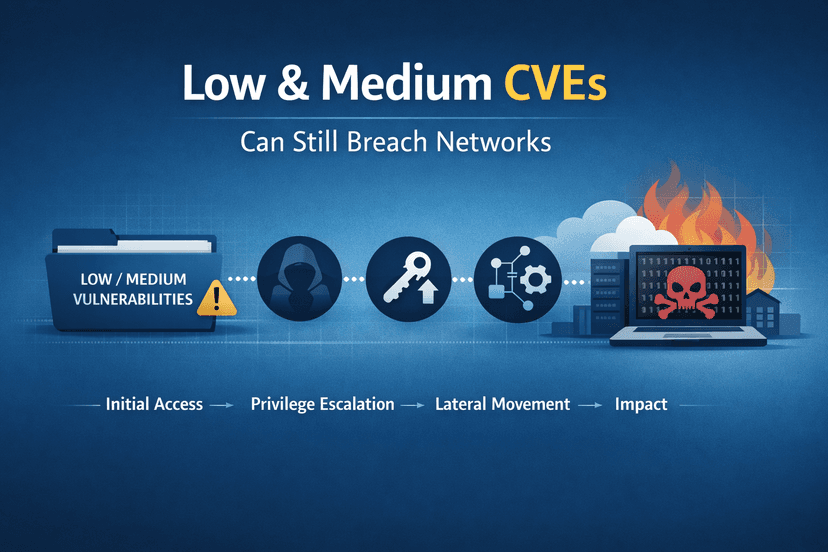
Why “Low” and “Medium” CVEs Still Breach Networks
In vulnerability management, severity ratings quietly shape behaviour. High and Critical CVEs trigger alerts, emergency patch windows, and executive attention. Low and Medium CVEs, by contrast, tend to sink into the backlog—scheduled, deferred, or ignored entirely. That complacency is increasingly misplaced.
The Weekly Cybersecurity Brief: January 30th, 2026
This week's cybersecurity brief covers Microsoft's emergency patch for the actively exploited Office zero-day CVE-2026-21509, critical vulnerabilities in Cisco UC products and Ivanti EPMM, plus the Nike ransomware breach exposing 1.4TB of data.
The Weekly Cybersecurity Brief: January 23rd, 2026
Under Armour investigates claims of a 72M customer record breach. Critical patches for Microsoft Excel RCEs, Veeam Backup RCE, and Cisco ISE. Ransomware operators continue targeting MSPs and supply chains.
The Weekly Cybersecurity Brief: January 16th, 2026
Microsoft’s January 2026 Patch Tuesday delivered fixes for 114 vulnerabilities across Windows, Office, Azure, Edge, SharePoint, SQL Server, and related components, including eight Critical bugs and one actively exploited flaw now in CISA’s Known Exploited Vulnerabilities (KEV) catalog.
Patch Tuesday January 2026
Microsoft's January 2026 Patch Tuesday dropped on January 13, delivering fixes for 114 vulnerabilities across Windows, Office, and server components—making it one of the heavier releases to kick off the year.

Top 20 CVEs Affecting Healthcare Infrastructure in 2026
Cybersecurity professionals in healthcare infrastructure face a uniquely high-stakes threat landscape in 2026, where exploited CVEs directly correlate with patient harm, ransomware lockdowns, and regulatory scrutiny.
CYBERSECURITY BRIEF: January 9, 2026
Google’s January 2026 Android Security Bulletin has highlighted a critical zero-click vulnerability affecting the Dolby Digital Plus Codec. The Threat: Attackers can execute arbitrary code or crash a device simply by sending a manipulated audio file.

The Jaguar Land Rover Cyberattack: A £2 Billion Wake-Up Call for Supply Chain Security
An in-depth analysis of the September 2025 Jaguar Land Rover cyberattack that cost the UK economy nearly £2 billion. Learn how unpatched vulnerabilities and supply chain weaknesses led to the most devastating cyber event in British history.

The Future of Vulnerability Management: AI-Driven Defense
As the volume of Common Vulnerabilities and Exposures (CVEs) continues to skyrocket, traditional manual triage methods are becoming obsolete. Security...

Automating CVE Monitoring with the BrilliantDog API
Learn how to leverage the BrilliantDog API to build custom alerts and integrate vulnerability data into your existing workflows.

The Psychology of Patching: Why Teams Delay Critical Updates
It's rarely laziness. Explore the cognitive biases and organizational pressures that lead to "patch paralysis" and how to overcome them.

5 Steps to Building a Mature Vulnerability Management Program
Move beyond simple scanning and create a risk-based vulnerability management program that actually reduces your attack surface.

Supply Chain Security: Why Dependencies are Your Biggest Risk
Modern applications are 90% open source code. Understand the risks hiding in your node_modules and how to secure your software supply chain.
MOVEit Transfer Zero-Day Exploited in Mass Attacks: What You Need to Know
A critical SQL injection flaw in MOVEit Transfer is being actively exploited by the Cl0p ransomware gang, affecting hundreds of organizations worldwide. Here's what happened and how to respond.
Chrome Zero-Day CVE-2024-7971: Why You Should Update Right Now
Google just patched CVE-2024-7971, a type confusion vulnerability in V8 that's being actively exploited. If you're using Chrome, update immediately.
Securing Your CI/CD Pipeline Against Supply Chain Attacks
CI/CD pipelines are increasingly targeted by attackers. Learn how to harden your pipeline and protect against supply chain attacks.
How to Actually Read a CVE (And Why Most People Get It Wrong)
CVEs contain crucial security information, but they're often misunderstood. Learn how to properly interpret CVE records and make better security decisions.
Kubernetes Security: Common Misconfigurations That Lead to Breaches
Kubernetes is powerful but complex. These common misconfigurations are repeatedly exploited by attackers - and most are easily preventable.
Building an Effective Vulnerability Disclosure Program
A well-designed vulnerability disclosure program helps organizations discover and fix security issues before attackers exploit them. Learn how to create an effective VDP.
What Happens When a CVE Gets Disputed? Inside the Controversy
Not every CVE represents a real vulnerability. Sometimes vendors and researchers disagree - and these disputes reveal important truths about vulnerability disclosure.
CVSS v4.0: What's New and Why It Matters
CVSS v4.0 introduces significant improvements to vulnerability scoring. Discover the key changes and how they impact vulnerability assessment and prioritization.
Ivanti Connect Secure VPN Exploits: The Gift That Keeps on Giving
Ivanti's VPN products have been hammered by multiple zero-days this year. Here's what went wrong and what it means for enterprise VPN security.
Critical Windows Print Spooler Vulnerabilities: PrintNightmare and Beyond
Windows Print Spooler has been a consistent target for attackers. Explore the history of Print Spooler vulnerabilities, their impact, and how to protect your systems.
The Real Cost of Ignoring "Low Severity" Vulnerabilities
That CVSS 3.2 vulnerability you deprioritized? It might be the one that gets you breached. Here's why low-severity vulnerabilities deserve more attention.
SQL Injection in 2024: Yes, It's Still a Thing
SQL injection has been around for decades, yet it remains one of the most common and dangerous vulnerabilities. Why haven't we solved this problem?
Understanding the Log4Shell Vulnerability: A Deep Dive into CVE-2021-44228
Log4Shell (CVE-2021-44228) was one of the most critical vulnerabilities discovered in recent years. Learn about its impact, exploitation methods, and comprehensive mitigation strategies.
Your Patch Management Strategy Is Probably Wrong
Most organizations approach patching reactively. Here's how to build a patch management program that actually reduces risk without breaking everything.
Breaking Down the MOVEit Transfer Vulnerability
Let's get technical. How did CVE-2023-34362 actually work, and what can developers learn from it?